
We tried ChatGPT and nothing changed. What do we do now?
It depends on building a process around the tool, not on the tool. A chat window helps whoever happens to open it, one conversation at a time, and then the work goes back to how it was. Things change when AI is built into one specific job your business already does: fed your own material, wired into the steps around it, and checked by a person who knows the work.
Evidence
Every AI system I have built started where a chat window stops. Each one takes one job, gives the model the material it needs, puts its output where the work actually happens, and keeps a person in the loop.
GEM drafts and enhances content from a bank of real writing examples, so it works in a known style instead of from a blank prompt. A person edits every piece before it is published, and the result goes straight into the site. It runs this site's Articles section.
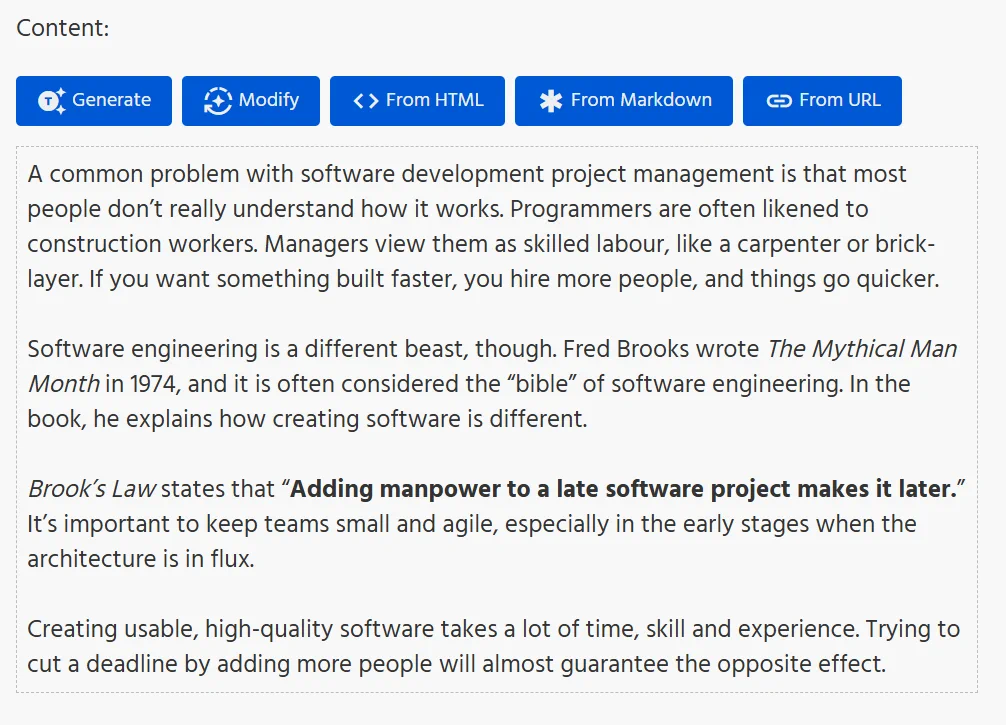
EduGen turns the steps of making a training video into a pipeline: it drafts the script, finds and ranks stock footage, voices the narration, assembles the video and publishes it. Each channel keeps its own settings, so every video starts from the same decisions, and the person editing picks the clips and approves the result.
FoodCoach reads a photo of a meal, identifies the food and its approximate portion size, and matches it against the USDA FoodData Central database to work out the nutrition. Nobody types a prompt: the photo goes in, and the answer is checked against standard data rather than trusted on the model's word.
The same models are behind a chat window. What made the difference in each case was the process built around them.
Read the GEM case study, the EduGen case study and the FoodCoach case study. For the places in a professional services business where AI usually pays off, and why starting small with human oversight matters, see Using AI to Boost Productivity in a Professional Services Business.
What it takes
One process, not AI in general. Pick a job your business does over and over, with a clear input and a clear result, and start there.
Your own material. Examples of your writing, your documents, your records or your settings, so the AI works from what your business already knows instead of a blank prompt.
A place in the workflow. The AI's output has to land where the work happens, in your site, your files or your systems, rather than in a chat someone has to copy from.
A check and an owner. Someone who knows the work reviews the results and is responsible for the process after it is built.
The honest limits: not every job is worth building around. Some are better left with a chat window, and some are better left alone. Telling which is which is the first step.
Next step
Tell me what you tried and where it stalled. The AI Audit looks at how your business actually works, finds the processes where AI would pay for itself, and tells you plainly which ones to build first.